

Healthy lawns: a how to guide for a Healthy Yard
Brought to you by Gardening at the U of S, the City of Saskatoon, the Saskatoon Food Bank and Learning Center Garden Patch, and the Saskatchewan Waste Reduction Council Compost Coaches!
Mowing
• Use a sharp mower blade.
• Raise the mower blade to keep grass 5 - 9 cm (2" - 4") inches tall. Taller lawns are more resistant to stress. The shading created by tall, thick grass conserves moisture and can help prevent weeds from establishing.
• Cut grass when it’s dry.
• Keep your grass clippings on the lawn to add nutrients and retain moisture.
• Keep thatch (the loose material closest to the ground) 2 cm (3/4") thick. Remove additional thatch with a hand rake.
• Give the lawn a thorough raking every spring.
Watering
• If your lawn is established, water it deeply, but not more than once a week (skip a week after a good rain).
• Newly seeded lawns should be watered every other day until the grass reaches 5 cm (2") tall. Newly laid sod should be deeply watered immediately after installation and then watered lightly every other day for about two weeks.
• If you leave footprints when you walk on your lawn, it is often a sign that your lawn needs water.
• Use the Tuna Can Test: Set a tuna can (6 oz) in each of your sprinkler zones and time how long it takes to fill it with water. That’s how long you should run your sprinkler system once a week, unless you’ve received a good rain.
• Check your sprinkler system frequently to ensure proper operation. Adjust sprinklers so only your lawn is watered and not the house, sidewalk, or driveway.
• Avoid watering during the heat of the day or during windy times. Instead, choose cool and calm times of the day (early morning) to minimize evaporation.
Weeding
• Pesticides and fertilizers are not required for a healthy lawn. Simply remove weeds by hand or with garden tools before they go to seed. The presence of a few weeds or insect pests will not affect the health of your lawn.
• Dandelions are a primary food source for bees in the spring. Help keep our bees safe by keeping your dandelions free of pesticides.
Fall Clean Up
Not a fan of raking leaves? There’s an alternative!
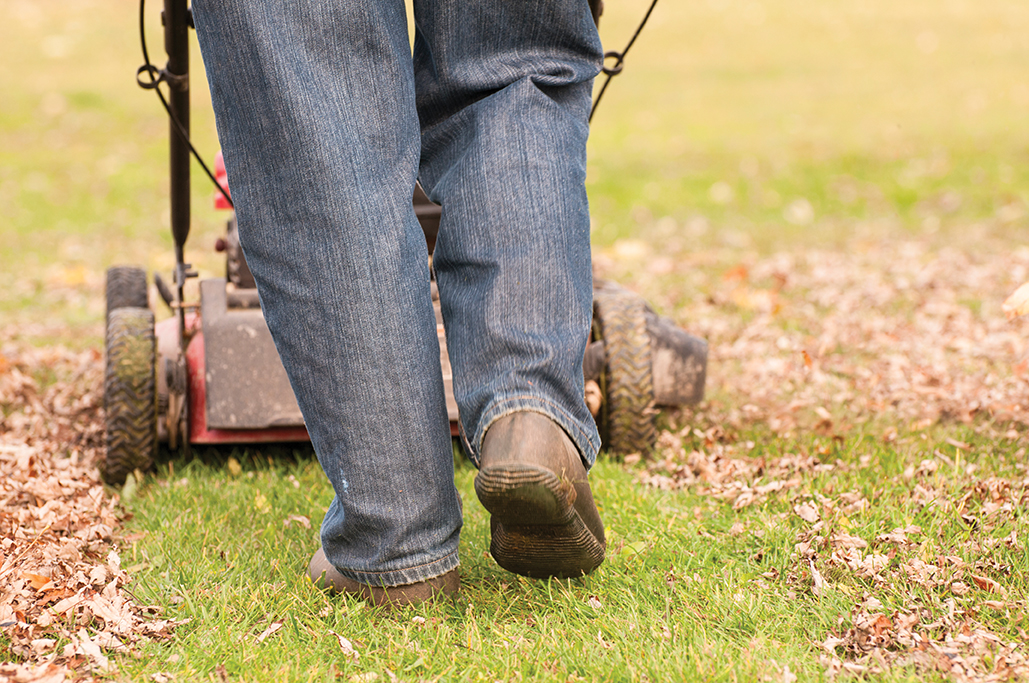
Every fall, we toss leaves in the garbage unnecessarily. Instead, add valuable nutrients to your lawn by keeping some of your leaves in place. A few passes with a lawnmower will break the leaves into dime-sized pieces that will settle into your lawn and decompose throughout the winter; come spring, they'll be unnoticeable!
Make sure you mow when leaves are dry, and mow no more than about 15 cm (6") of leaves at a time. Spread the chopped leaves throughout your lawn, and use the rest as mulch in your flowerbeds and vegetable garden, or add to your compost bin.
Rethinking the Traditional Lawn
• Plant native grasses adapted to our climate. The Native Plant Society of Saskatchewan (npss.sk.ca) has plant and supplier lists available on their website.
• Plant a mixture of different grass varieties in your lawn, even if they look very similar. As seasons change or as drought, cold, or disease hit, some of your grasses will outperform others and keep your whole lawn looking healthier.
• Mixing traditional and native grass seeds is not recommended as native grasses do not compete well against many non-native grass species.
• Consider including about 5% clover in your grass seed mix, which will supply approx. half the nitrogen your lawn needs. Try white Dutch clover (non-native) or purple prairie clover (native).
• Buy your lawn and groundcover seeds from a specialized retailer. The important thing is to make sure the seeds are adapted to our climate.
• Use low groundcovers, such as woolly thyme, near pathways and between stepping stones.
• Replace unused areas, such as the strip of lawn beside your driveway, with low maintenance perennials or drought tolerant grasses.
Nutrients
• Apply 3 cm (1") of compost to your lawn every year to keep it healthy. Use a rake to spread it evenly.
• Keep grass clippings on the lawn during mowing. This will provide nitrogen for your lawn, as well as many other benefits.
• If you follow the simple tips in this brochure, your lawn will not need additional fertilizer to keep it looking healthy. However, if you do decide to apply fertilizer to your lawn, never apply it after mid-August, as it encourages new lush growth that does not harden off properly for winter.