

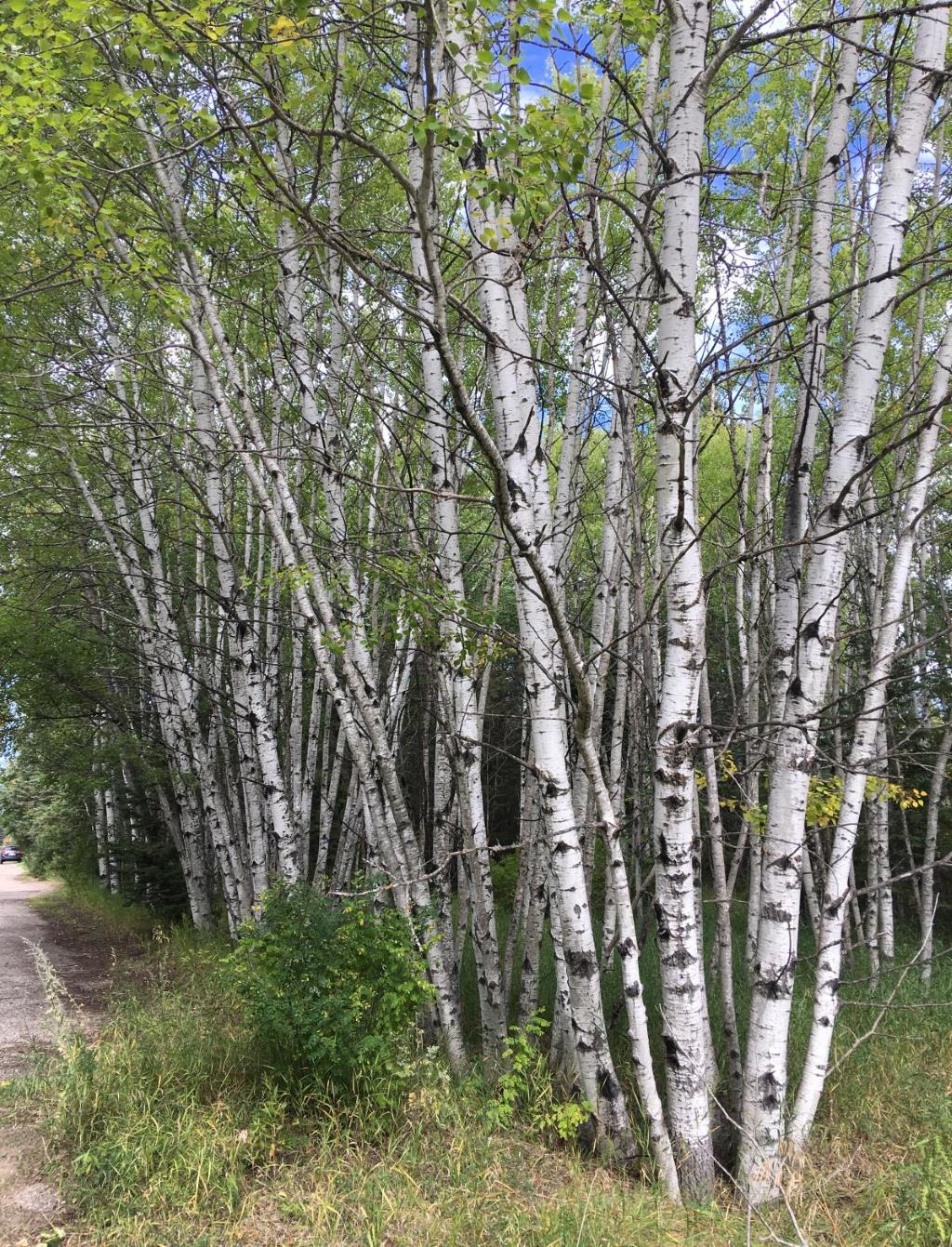
Trembling aspen
Populus tremuloides
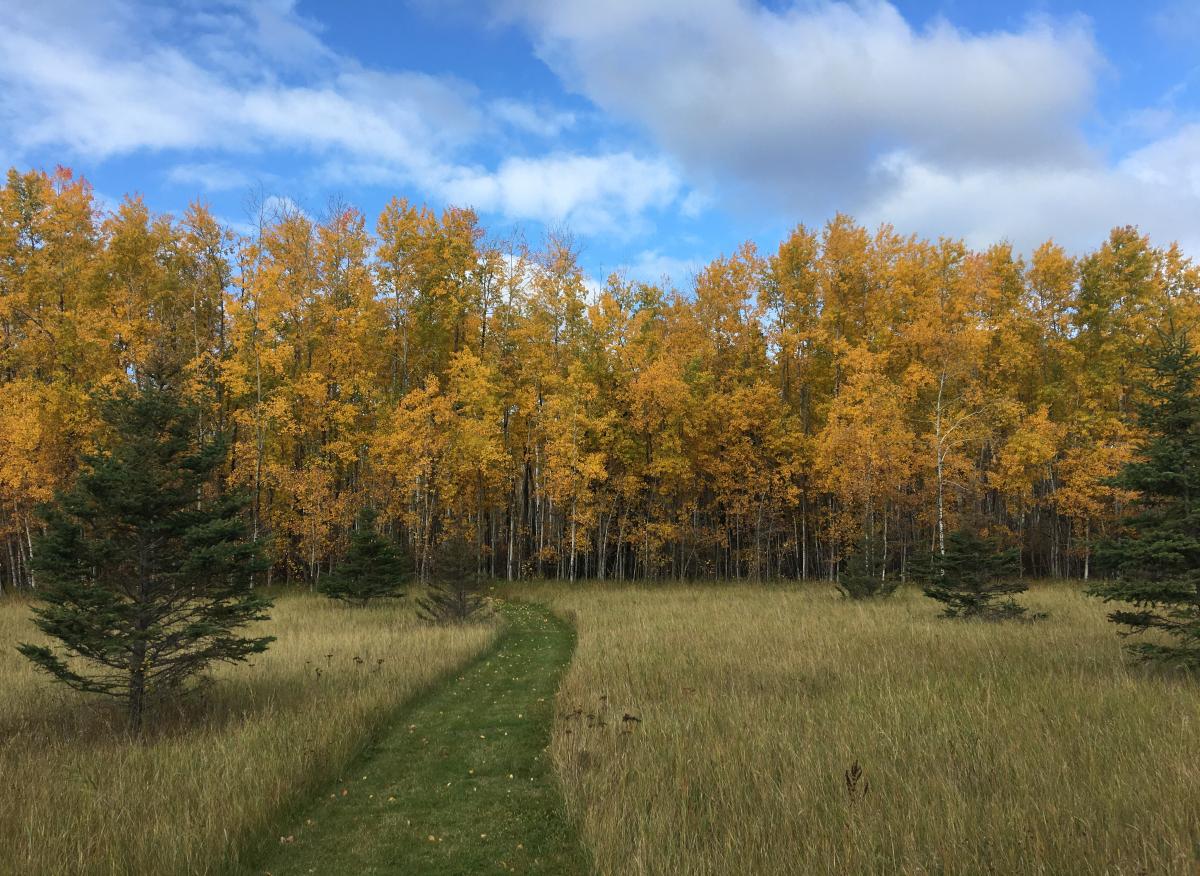
In stark contrast to the columnar Swedish aspen, our native trembling aspen (also called quaking aspen) is quite lovely. Populus tremuloides is an extremely common North American species with small, fluttering leaves that turn bright yellow in the fall and beautiful, smooth bark with black lenticels. It grows 50-60 ft. and is sometimes cultivated.
Of great importance to aboriginal peoples, the white, chalky powder on the stems was used to make a very effective sunscreen for the first European settlers, so that they would not fry in the hot prairie sun. The ashes from burned aspens logs were used as a salt replacement and tea from the bark was used to treat jaundice, fevers, and to kill intestinal worms.
There are a great many hybrid poplars and aspens, some naturally occurring, some selected and developed through planned breeding programs. We have chosen to include just a small sampling of some of the better known and more important varieties, but new varieites appear frequently.
Populus x acuminata- A naturally occurring hybrid found throughout western North America. It is a cross between P. angustifolia and P. deltoides. It occurs wherever their ranges overlap. It is a fast growing, sterile tree reaching 50-70 ft. and occasionally cultivated.
Populus x ‘Assineboine’- A hybrid of somewhat unknown origins, this hardy and vigorous selection is a cotton-free male clone reaching 50-60 ft. It has lovely yellow fall color and is more drought resistant than many forms of poplar. An ideal shelterbelt tree. Zone 2.
Populus x ‘Brooks’- Developed at the Experimental Farm in Brooks, Alberta and released in 1954. This extremely rapid growing, male selection can reach anywhere from 40-80 ft. and can grow as much as 20 ft. in a five year period if conditions are good. It retains its leaves till quite late in the fall, eventually becoming an attractive dull gold. It is a cross between P. deltoides and the Russian species P. petrowskyana.
Populus x canadensis- A narrow hybrid from Manitoba that was created by crossing P. deltoides with P. nigra. 80-100 ft. Zone 3.
Populus x canescens- A very famous hybrid between P. alba and P. tremula. The best known form is the tower poplar (Populus x canescens ‘Tower’), which was an introduction from the Morden Research Station in Manitoba. It is a fast growing seedless form that can be distinguished from the Swedish aspen by the darker green, more oval shaped leaves that are paler beneath than above. Not quite as dense as the Swedish aspen, this tree can be used almost interchangeably with it. There is a prevailing belief that the tower poplar is somehow inferior to the Swedish aspen when really, they are comparable enough that unless you are a very keen gardener, you likely won’t even notice the difference. At maturity, tower poplars are also a little bit wider than the aspen. The Morden Research Station actually developed a number of columnar poplars with the intent that they were to be used as windbreaks and shelterbelts for farms and acreages. (‘Prairie Sky’ is one such noteworthy form that is still widely used.) While good trees for shelterbelts, they are not particularly well suited to gardens.
Populus x jackii- A natural hybrid between P. balsamifera and P. deltoides, occasionally cultivated. Depending on what form the cross takes, these offspring can be anywhere between 30 and 100 ft. tall at maturity. Known for their vigorous growth habits and particularly large leaves (sometimes up to 8” in diameter) there are a few good, named forms. ‘Northwest’ is particularly noteworthy and tough. It is well suited to farms and shelterbelts, coloring up a brilliant yellow in the fall. All of these hybrids are sterile with no cotton fluff to worry about.
The “crooked trees” are one of the most unusual groups of trees on the Canadian prairies, and can be found not far from the tiny town of Hafford, Saskatchewan. This is a clonal grove of trembling aspens that have grown in twisting, crooked, winding, contorted, corkscrew-like shapes. They are both beautiful and eerie, and have attracted attention from tree biologists all over the world. The strange loops, twists, and contortions of the trees are due to a very rare genetic mutation, but what is not clear is why this mutation has occurred. Cuttings from these trees grown in Manitoba have all grown in the same strange fashion. Absolutely worth making a road trip for.