

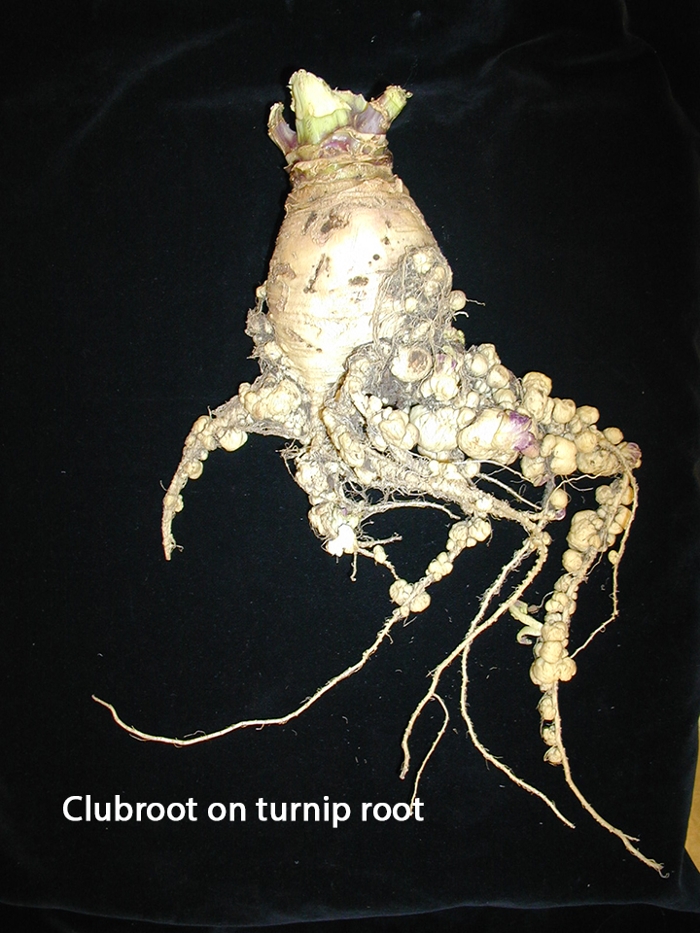
Clubroot
Plasmodiophora brassicae

Clubroot, caused by Plasmodiophora brassicae, is soil-borne disease. This is a serious disease of canola, but it also affects vegetable such as cabbage, broccoli, rutabaga, kohlrabi, Brussels sprouts, cauliflower, radishes and kale. Weeds such as wild mustard, shepherds purse and stinkweed can also serve as hosts to the disease.
When it gets into the root, it causes the cells to grow and divide rapidly to form galls that in turn inhibit the plants ability to absorb water and nutrients. This leads to stunting, yellowing and premature death of the crop. The disease is favoured by warm, moist soils – the same conditions that vegetables like! While a pH below 6.5 may be preferred by the clubroot pathogen, the disease can occur in more alkaline soils.
Late in the season the infected roots will begin to disintegrate and release resting spores of the clubroot pathogen into the soil. Every time a host crop is grown, the levels of resting spores will increase, increasing the potential damage and yield loss caused by the disease. These spores can be transported in soil attached to vehicles, equipment like rototillers, wind, water, animals and shoes.
For the home gardener, the most likely method of introducing the disease might be on the soil attached to seed potatoes. Since it can be difficult to practice three-year crop rotations in smaller vegetable gardens, prevention is the best practice.
Once
Best practices for Clubroot prevention and management:
- Do not source seed potatoes from areas where clubroot is known to exist.
- Minimize the movement of soil from by cleaning off equipment, especially on rototillers that may be used in numerous gardens.
- Rotate the location of your brassicas in the garden every year. Do a three-year rotation at a minimum.
- Control volunteer canola and brassica weeds.
- Pay attention to your brassica plants. Look for stunting and yellowing that might be occurring, although this might be due to many other causes. Near the end of the growing season, uproot the plants and look for swollen root tissue (clubroot galls).
- Remove any infected plants and place in the garbage or burn if appropriate. Do not plant brassicas in the same area.
In Saskatchewan, Clubroot has been declared a pest under The Pest Control Act. As such, Pest Control Officers can be appointed to enforce, enter land, collect specimens and issue orders. This also allows for development of bylaws to prevent, control or destroy clubroot.
While Clubroot has been known to exist in many vegetable growing regions in Canada in the past, it has recently been confirmed in a few locations in Saskatchewan and Manitoba and has become quite prevalent in the seed potato growing regions of Alberta.
For more information on this disease, please visit Canola council clubroot disease information on https://www.saskatchewan.ca/government/news-and-media/2024/january/09/2023-clubroot-distribution-in-saskatchewan, or call the Agriculture Knowledge Centre, toll free at 1-866-457-2377 or email aginfo@gov.sk.ca.
Related research: Clubroot research at the University of Saskatchewan