Drying Cannabis
The final (and very important) step before you can enjoy the buds of your labour!
By Chase BoucherOverview
Once your cannabis has been harvested, it now needs to dry. Drying is straightforward but needs to be done correctly to both maintain the flavour profile of the plant and get it to the form where it can be used and enjoyed. You can only dry your plants once, so it is important to do it right the first time!
Fresh cannabis plants are roughly 90% water compared to properly dried cannabis, which is ideally between 10% and 13%. This is a lot of water to lose! When wet trimmed, most average sized cannabis plants should take 10-14 days to fully and properly dry under ideal conditions, depending on bud density. The most substantial size and weight reduction happens in the first 4 to 5 days – this is when most of the water is lost. Afterwards, water loss slows, buds tighten up, and chlorophyll and other plant compounds begin to change and/or break down. If cannabis is dried too quickly, these compounds can remain in the buds, imparting off flavours and greatly reducing the quality. If you have ever had cannabis that burns poorly and smells like hay, this is likely why. Drying should also be done in the dark as light and UV can degrade the resin quality.
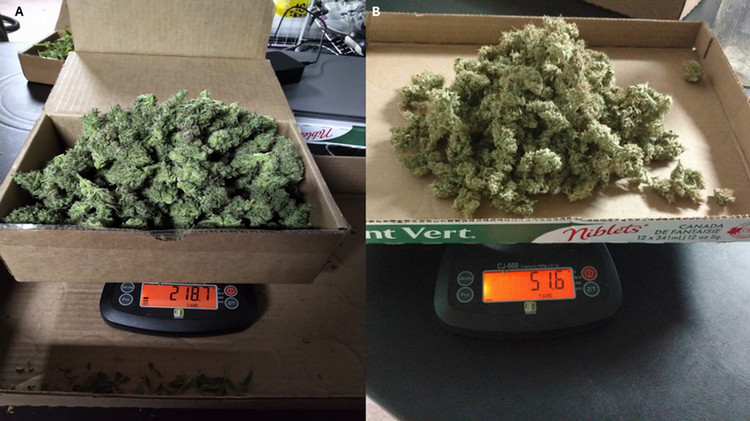
Drying is complete when the buds/branches have lost approximately 75% of their original weight. For example, if a branch weighs 40 grams wet, it should weigh about 10 grams when properly dried. Another common way of assessing dryness is whether the bud “snaps” or breaks off the stem. If it cleanly breaks and separates, it is most likely dry enough. If it peels along the stem or bends but doesn’t break, it still needs a few more days. After drying, the buds can be removed from the stems and stored.
Where Can I Dry My Cannabis?
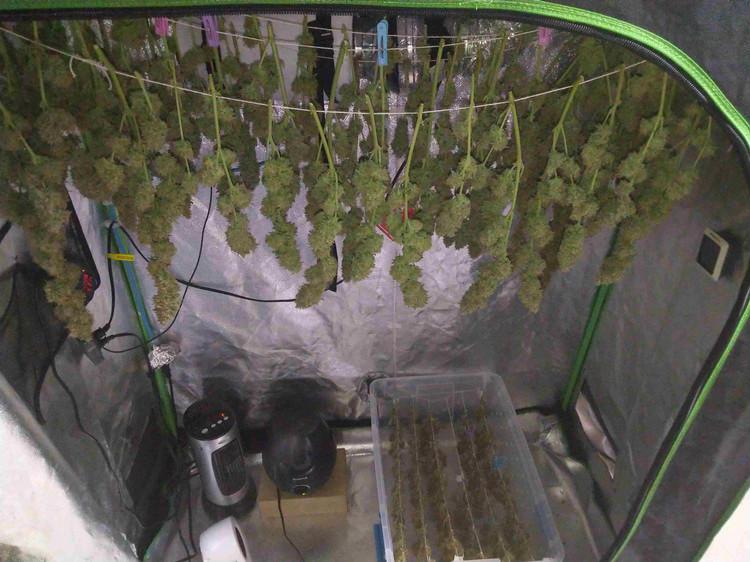
This can be done anywhere that you can maintain a constant temperature of 16°C to 23°C (the lower the better) and between 50% and 60% relative humidity. The air inside the space should be also able to be refreshed periodically and potentially passed through an odour control system such as a carbon filter (if needed - it will be very smelly!). Many growers (the author included) opt to use their grow tents to dry their harvest as they are mostly isolated from the outside environment with good control over intake and exhaust. Branches are hung from the ceiling of the tent using string or wire to slowly dry.
Temperature and Humidity
The two most important factors as they must be kept within a specific range – 16°C to 23°C and 50% to 60% relative humidity. If temperatures are lower, drying can slow, leaving potential for fungus to begin to grow. Temperatures greater than 21C can cause the loss of certain compounds like terpenes and other volatile substances, as well as cause uneven drying in the buds. Humidity is as important, if not more important than temperature. Having too much humidity will slow the drying time substantially, as well as provide an ideal environment for fungus like Botrytis cinerea to grow and ruin your hard work. Having too little humidity will cause uneven drying as well as increase the rate. If cannabis is dried too quickly it tends to burn poorly and have off flavours, greatly diminishing the enjoyability of the flower.
How to Setup Your Drying Tent
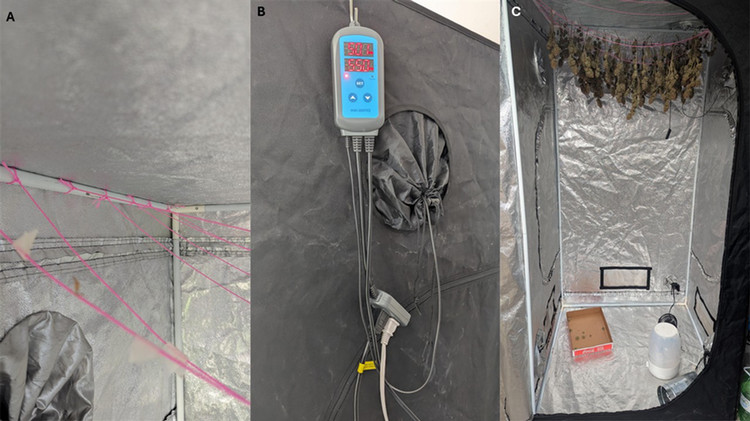
Equipment needed: Grow tent, exhaust fan/carbon filter, humidifier, humidity controller, small fan, hygrometer (measures humidity), string.
Prepare your drying area before harvest is started. Here in Saskatchewan, we tend to have a dry climate, especially during the winter months. Relative humidity levels in Saskatchewan can often get as low as 20%, making drying cannabis properly somewhat challenging. To remedy this, it is recommended to utilize a tent with a humidifier and exhaust fan connected to a controller. The controller should be set to exhaust the air if the humidity is above 56% and to activate the humidifier when humidity drops below 54%. The author has found this to be an excellent way to maintain ideal conditions within an enclosed space (like a grow tent) and has used this method for may years.
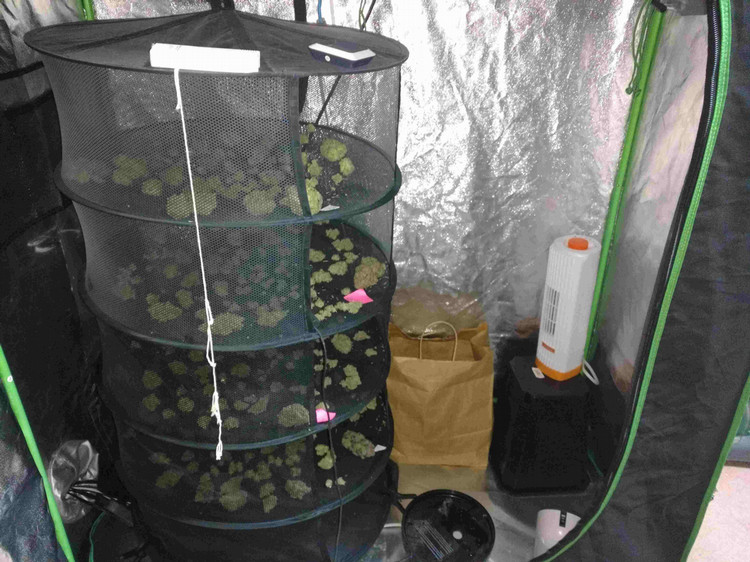
Also ensure you have a way to hang your branches. The author prefers to run lengths of string across the top of the tent tied to the frame, enabling plants to be hung in rows. Rather than hanging branches, some growers opt to use mesh drying racks where the branches or buds are laid on the different tiers. An exhaust fan is also needed to refresh the air within the drying area. As the plants lose water, humidity will climb and so will need to be refreshed to maintain optimal levels. This air will be quite smelly so ensure a carbon filter is used if needed.
Setup steps
- Remove light from tent. If using string for hanging branches, run lengths across top of tent. Space each length at least 15cm apart. For smaller harvests, growers often use wire clothes hangers hung on the crossbar of the tent. Feel free to improvise as needed! If using drying rack, hang in tent.
- Setup exhaust fan, humidifier, and humidity controller. The controller should be able to set to an ideal relative humidity % and will activate the humidifier or exhaust fan when it deviates away from this ideal by a specified amount (the author prefers plus or minus 1%). This means that when set to 55% relative humidity, if it falls below 54% the humidifier activates while above 56%, the exhaust fan activates.
- Position small circulation fan so it will move air around buds but not blow directly on them. Place hygrometer inside tent, ideally around the level of the buds, or just slightly lower. The author uses a magnet to attach it to the wall of the tent. Be sure it is not in a direct path of the humidifier, or the numbers will be skewed.
- Close tent door and turn everything on to test and ensure everything is setup and working properly. If a relative humidity of about 55% (give or take a few %) is maintained, you are ready to dry!
- Over the 10-14 days, check to ensure that the humidifier does not run out of water. Watch for signs of mold on buds, especially in the first 4-6 days.
- When buds have lost approximately 75% of their original weight and/or easily break off the stem, drying should be complete and the cannabis can now be used and/or stored.